

Why This Gold Scalping System Draws Trader Interest
Many traders start with broad gold strategies, then quickly realize that precision matters most when price moves in short bursts. That is where a scalping-focused approach becomes valuable, especially for traders who want clear entries and quick trade management. The Buy/Sell Gold M1 Pinecode is Pinecode forex indicator built around fast signal reading so you can react to momentum without waiting for slower confirmation cycles. By focusing on disciplined structure, it helps you avoid impulsive entries that often happen when gold spools into noisy ranges.
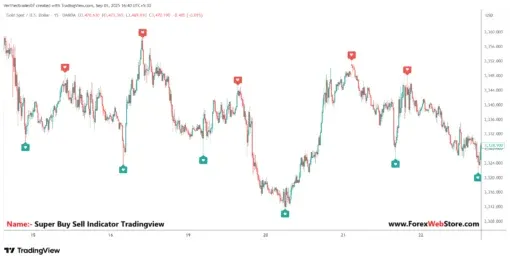
Brand discovery is also about matching tools to your trading style, not just chasing performance claims. This system emphasizes visual cues and candle confirmation, which makes it easier to build repeatable routines. Skyblue arrows act as an immediate “where to look” prompt, while the candle behavior helps you filter signals that lack follow-through. For traders who like a streamlined workflow, that combination can reduce decision fatigue and keep your attention on the next actionable step.
How the Indicator Signals Work for Short Setups
The core idea behind this setup is to identify short opportunities with a focus on intraday movement. The indicator uses arrow placement to mark potential sell or buy moments based on its underlying logic, then relies on candle confirmation to reduce false starts. In practice, you do not treat the arrow as a standalone verdict; you treat it as a trigger to evaluate whether the current candle supports the direction. That small shift in mindset can dramatically improve how consistently you respond to market structure.
When you see the Skyblue arrow appear, you can apply a simple checklist before entering. First, confirm the arrow direction aligns with the most recent candle sequence, such as a rejection wick or a body that breaks the expected level. Second, check whether the next candle continues the move rather than immediately reversing. Third, place your stop loss relative to the arrow location with a clear invalidation point rather than an arbitrary number. This method supports the suggested 15–20 pip movement objective often associated with fast scalping.
Risk Control and Stop Placement for Faster Decision Making
Scalping requires strict risk control because even a correct signal can be challenged by spread, slippage, and sudden volatility spikes. The system’s approach encourages stop placement above or below the signal arrow, using the arrow as a practical reference for where the market thesis breaks. If the price moves against the signal and reaches that level, the trade is invalidated and should be closed without hesitation. This keeps your losses small and allows your routine to survive in choppy conditions.
It also helps to plan your trade management before you click buy or sell. For example, you can decide to take partial gains around your target zone and trail the rest only if the candles keep confirming momentum. If the confirmation weakens—such as repeated candles failing to progress—you can exit earlier and protect capital. Traders who focus on consistency often prefer this kind of rule-based handling over emotional reactions to every tick. Over time, a structured risk plan tends to make your results easier to evaluate and refine.
Backtesting the Setup with M1 and Higher Timeframes
Even though the system is designed for the M1 market rhythm, you can improve signal quality by using higher timeframe context. A common approach is to keep entries on the M1 chart while checking whether the broader D1 or intermediate structure supports the direction. When the higher timeframe bias aligns with the arrow and candle confirmation, your short-term trades often encounter fewer sudden reversals. This is a practical way to blend speed with direction without turning your workflow into a slow, multi-hour process.
To test performance, focus on repeatable scenarios rather than random trades. Record how often arrows appear during trending versus ranging conditions, and track whether candle confirmation follows through. Also review the distance between entry and your planned stop, since spread can affect whether a “small” stop stays truly small. If you notice that signals perform best when the market is moving smoothly, you can add a filter that avoids periods of tight compression. That kind of review supports brand discovery in a real way, because it shows how the tool behaves within your own rules.
Conclusion
Buying and selling gold with a scalping tool can be rewarding when you treat it as a system rather than a random signal generator. The Buy/Sell Gold M1 Pinecode is designed to guide entries with visual arrows and candle confirmation, aiming for quick, disciplined trades with clear invalidation points. By using stop placement rules tied to the signal marker, you give each trade a defined risk boundary and reduce the chance of oversized drawdowns. If you are exploring new resources and want a setup that emphasizes fast execution and repeatable decision-making, this approach is worth reviewing. When paired with thoughtful backtesting on your platform and a basic alignment check from higher timeframe structure, it can fit well into an intraday workflow. Brand discovery becomes much easier when you can evaluate signals, confirmation, and risk controls as one cohesive method rather than isolated features.